
You know X-pipes and H-pipes. The Z is the newest letter in the crossover family — and the one most people can't explain yet.
If you've spent any time shopping exhaust parts, you already know most of the alphabet. X-pipe, Y-pipe, H-pipe — each one named for the shape it makes, each one a part you can picture without looking it up. They show up in every catalog, every build thread, and every conversation about how to put a system together.
Three of those four are doing versions of the same job. On a dual exhaust system you have two separate pipes carrying two separate streams of exhaust, and a crossover is the section that connects them. An H-pipe runs a short tube between the two sides so pressure can equalize across them. An X-pipe goes further, merging the two streams through a crossing junction before splitting them back out. A Y-pipe isn't a crossover at all — it permanently merges two pipes into one, or splits one into two, and exists to change the system from dual to single or back.
The Z-pipe is the newest addition to that family, and it belongs in the same conversation as the X and the H. It's a dual-exhaust crossover: two inlets, two outlets, with the two pipes crossing over and blending through each other in the middle. Same fundamental purpose as an X-pipe — connect the two sides of the system so the exhaust streams interact — arrived at through different geometry.
The reason most people can't explain it yet is simply that it's new to the catalog. X-pipes and H-pipes have been standard parts for decades, with forum threads and sound clips going back generations. The Z-pipe has had a few years. The result is that search results for it are thin and inconsistent, and a lot of enthusiasts who'd genuinely benefit from one have never seriously considered it.
So here's the full picture: what a Z-pipe is, how the geometry differs from an X and an H, what it does for sound and flow, and how to pick the right one for your system.
Before the letters make sense, it helps to understand the problem they're all solving.
An engine doesn't push exhaust out in a steady stream. It fires one cylinder at a time, and each combustion event sends a distinct pressure pulse down the pipe. On a V-configuration engine with a dual system, those pulses are split between two banks, and because of the firing order they don't arrive evenly on either side. One pipe gets a burst while the other is comparatively quiet, then it flips.
Run those two pipes completely separately — true duals with no connection — and each side deals with its own pulses in isolation. Connect them, and the high-pressure pulse on one side has somewhere to expand into. That's the whole idea behind a crossover.
Two things come out of that:
Every crossover design — X, H, or Z — is chasing those two outcomes. What separates them is the path the gas takes to get between the two sides, and that path is what shapes both how much flow disturbance the crossover introduces and what the car ends up sounding like.
A Z-pipe is a dual-exhaust crossover section built from two pipes that cross over one another and blend through the middle of the assembly. It has two inlets at the front and two outlets at the rear — one for each side of your system — and it installs as a mid-pipe section between your front pipes and the rest of the exhaust.
What makes the geometry distinct is the angle of the crossing. An H-pipe connects its two sides with a tube running roughly perpendicular to the direction of flow, so any gas moving between banks has to turn hard out of one pipe and hard back into the other. An X-pipe brings the two pipes together at a single junction point where they merge and separate. A Z-pipe spreads that interaction out — the two tubes angle across each other over a longer transition, so the crossover happens along the direction the exhaust is already traveling rather than across it.
That's the core of the design argument. Gas doesn't like changing direction, and every hard turn in an exhaust path is a place where flow gets disturbed and energy is lost as turbulence. Keeping the crossover aligned with the direction of travel is a way of getting the pulse interaction you want with less of the disruption that comes with a perpendicular branch.
H-pipe — two pipes joined by a tube running across them. The connection is perpendicular to flow.
X-pipe — two pipes merged and split at a single crossing junction.
Z-pipe — two pipes crossing and blending through an angled transition, working with the direction of flow rather than across it.
Y-pipe — not a crossover. Permanently merges two pipes into one, or splits one into two.
A Z-pipe is a mid-pipe component. It sits after your front sections — headers, downpipes, test pipes, or catted pipes, depending on the build — and before your mufflers or rear section. As a general principle, crossovers do more work the further forward you can package them, since they get to act on the pulses earlier. In practice, where it lands is a compromise between that ideal and whatever clearance you actually have under the car.
It requires a dual exhaust system. Two inlets and two outlets mean there have to be two pipes for it to connect. If your car runs a single pipe from the front of the system back, there's nothing for a crossover to cross over, and a Y-pipe or a straight section is the part you're looking for instead.
Here's how the family compares across the things that actually drive the decision.
| Design | How the sides connect | Crossover path vs flow | Typical tone character | Where it tends to help | Requires dual system |
|---|---|---|---|---|---|
| Z-Pipe | Pipes cross and blend through an angled transition | Aligned with direction of travel | Smooth and blended, in similar territory to an X-pipe | Broad — pulse interaction with minimal directional change | Yes |
| X-Pipe | Merged and split at a single crossing junction | Angled, concentrated at one point | Higher-pitched, smoother, often described as exotic | Upper rev range | Yes |
| H-Pipe | Short tube running between the two pipes | Perpendicular — hard turn each way | Deeper and bassier, traditional muscle car character | Low and mid range | Yes |
| Y-Pipe | Permanently merges two into one, or splits one into two | Not a crossover | Depends entirely on the resulting system | Converting between single and dual routing | No |
| No crossover (true duals) | Sides never connect | N/A | Two banks audible separately, less unified | Simplest to package | N/A |
Tone descriptions reflect widely reported characteristics across the aftermarket and are directional, not measured. Actual results depend heavily on the rest of the system — muffler selection, pipe diameter, and whether catalytic converters are present all matter as much or more than crossover style.
The most reliable generalization in this whole category is what the H and the X do to frequency content. H-pipes tend to preserve lower frequencies, which is where that deep, traditional rumble comes from — it's the sound most people associate with American V8s. X-pipes cancel more of the low-end content and let higher frequencies through, producing a smoother, more European-sounding note that gets sharper as revs climb.
Because a Z-pipe blends the two streams through a merged transition rather than a perpendicular tap, it lands nearer the X-pipe end of that spectrum — a unified, smooth note rather than a separated rumble. That said, anyone telling you a crossover alone determines your exhaust note is overselling it. The muffler is the single biggest variable in how a car sounds, followed by diameter and whether you're running cats. The crossover shapes character; it doesn't set it.
Worth being straight about this. Crossovers of every type produce real but modest gains, and the numbers are heavily dependent on the engine, the rest of the exhaust, and where the crossover sits in the system. A crossover working with a well-matched system contributes; a crossover bolted into an otherwise restrictive setup can't do much on its own.
What you can reason about confidently is flow path. Every hard directional change costs you something in turbulence and lost velocity, and a crossover that keeps the interaction aligned with the direction of travel gives the gas an easier route than one that forces it through a perpendicular branch. That's a geometry argument rather than a dyno claim — but it's the reason the design exists, and it's the case for choosing a Z over an H if smooth flow is what you're after.
You get the pulse interaction and scavenging effect that makes crossovers worth running, through a path that keeps the exhaust moving in the direction it was already going. Compared to an H-pipe's perpendicular tube, that's a meaningfully gentler route for gas moving between the two sides.
Blending the two banks together is what stops a dual system from sounding like two separate engines running next to each other. If your car currently runs true duals with no crossover and sounds slightly disjointed or uneven, this is the part that fixes it — and it's usually a more noticeable change than people expect.
A universal crossover isn't tied to a chassis. Available in the three diameters that cover most street and track systems, it goes into any dual setup where the piping matches. If you change platforms, swap mufflers, or rebuild the system later, a universal 304 stainless section carries over. Vehicle-specific parts don't.
304 stainless is corrosion-resistant throughout the material rather than surface-coated, so cutting it to length doesn't compromise it — which matters on a part designed to be trimmed and welded into a custom system. It's also the most forgiving of the common exhaust grades to weld cleanly.
A crossover is one variable in a system, not a bolt-on power adder. Adding one to a well-built dual exhaust makes a real difference to how the system sounds and how the two banks work together. Adding one to a stock, restrictive exhaust and expecting a transformation will disappoint you. Build the system properly and the crossover does its part.
Exhaust tubing generally comes in three grades, and the differences are real.
It welds cleanly. 304 is austenitic, which makes it more forgiving to TIG and less prone to cracking as the weld cools. Ferritic grades like 409 are weldable but more likely to go brittle near the joint without the right filler and technique. On a crossover with multiple joints being fitted into a custom system, forgiving is worth something.
Cutting it doesn't compromise it. This is the one that catches people out with aluminized tubing. The corrosion protection on aluminized steel is a surface coating — trim the pipe to length and you've exposed bare steel at the cut, then you weld over it. Stainless is corrosion-resistant all the way through, so trimming it anywhere leaves it stainless.
The environmental case is straightforward too. Exhaust systems collect moisture internally from combustion, and short trips never get hot enough to burn it off. Add road salt in winter or coastal humidity year-round and material choice starts showing up in service life. In South Florida, where salt air is a constant, it isn't a close call.
For a dual system that needs a crossover, the piece worth looking at is the Kents Universal Z-Pipe. It's a 304 stainless crossover section available in the three diameters that cover the overwhelming majority of street and track builds, with no vehicle-specific brackets or hangers to work around.
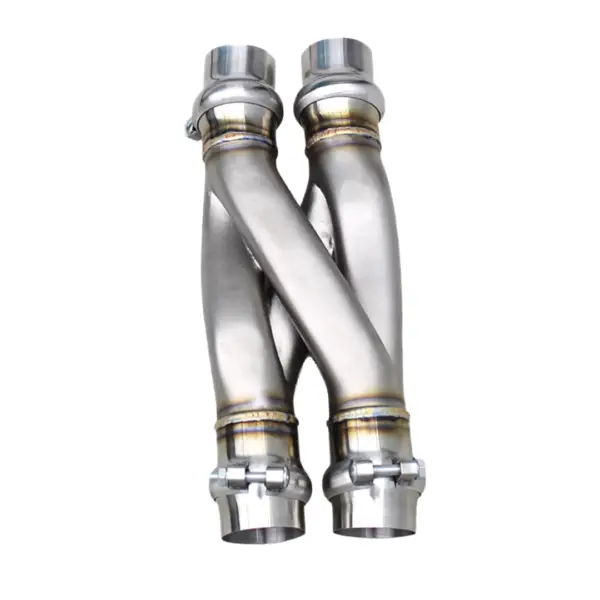
Three things make it a straightforward recommendation. The material is 304 rather than a coated or lower-grade stainless, so it survives being cut, welded, and daily driven through weather. The matte polished finish means it looks finished under the car without needing anything done to it. And the three-diameter range covers the practical spread — 2.5″ for most naturally aspirated street builds, 3″ for higher-output and boosted systems, and 2.75″ for applications that fall between the two or need to match existing piping that isn't a round number.
It's also genuinely universal. No brackets, no hangers, no assumptions about your chassis — just pick the diameter that matches your dual system and fabricate it in.
For a mid-pipe crossover, the answer is usually simpler than people expect: match what's already on the car. A crossover is not the place to change diameters. If your front sections are 2.5″, run a 2.5″ Z-pipe. Stepping sizes mid-system creates internal ledges that disturb flow, and you'd need adapters at every transition anyway.
If you're specifying a system from scratch, general guidance for street builds runs roughly like this:
Those are starting points, not rules. Bear in mind that a dual system splits flow between two pipes, so each side handles roughly half the volume and can run smaller than a single-pipe setup would need for the same engine. And bigger isn't automatically better — oversizing a naturally aspirated system slows exhaust gas velocity, which weakens the scavenging effect and typically costs low-end torque. Boosted engines are more forgiving, since the turbo itself is the dominant restriction.
Exhaust tubing is specified by outside diameter, not inside. Measure the OD of the pipe you're mating to, not the opening you can see. A tape measure across the outside of the tube is all you need — and it's worth doing before you order rather than after.
A universal crossover is a fabrication part. It's designed to be cut and fitted into a system rather than bolted to factory mounting points, so plan on either welding it in or clamping it with the appropriate hardware.
The stronger, cleaner, and more leak-resistant option. TIG on 304 gives the best result, and back-purging the joints with argon matters more than most people realize — an unpurged stainless weld develops rough oxidation on the inside that corrodes from within over time. A properly purged joint reads silver to light gold on the back side. The sequence that saves headaches: tack everything, get the car back on the ground or at least off the jack, check every clearance, and only then weld it out. Stainless moves as it cools, and finding that out after the joints are finished is a bad afternoon.
Faster and reversible, which is worth something on a build you're still working out. Band clamps or wide-band clamps are the better choice over U-bolt style — U-bolts point-load the tube and deform it oval, which hurts the seal and makes the joint hard to separate later. V-band flanges are the premium option: they need welding to install, but once on, the section comes off in seconds.
This one is specific to crossovers. Because the part connects the two sides of your system, anything asymmetric in how you fit it carries through to how the system behaves. Keep the two front sections feeding it as close to equal in length and routing as your packaging allows, and mount the crossover square rather than cocked to one side. Support it with hangers like any other section — an unsupported run puts all the load on the joints and lets the assembly move against nearby components. Check clearance to fuel lines, brake lines, and wiring with the suspension loaded, not just with the car in the air.
The crossover is one of the more underrated decisions in a dual exhaust build. Most people put real thought into the muffler and the diameter, then treat the mid-pipe as whatever happens to connect the two ends. But the crossover is where both banks of the engine meet, and that meeting shapes how the system sounds and how well the two sides work together.
If you already know you want the deep, low-frequency rumble of a traditional muscle car, an H-pipe is a well-understood way to get there. If you want the two banks blended into a single smooth note with the exhaust streams interacting through a path that keeps flow moving in the direction it's already headed, that's the case for a Z-pipe — and the reason the design showed up in the first place.
The Kents Universal Z-Pipe covers that job in 304 stainless across the three diameters that fit most builds — no brackets to work around, no platform assumptions, just the geometry in a material that holds up to being cut, welded, and driven. Match the diameter to your system, fabricate it in, and let the rest of the exhaust do its part.
304 stainless, matte polished, in 2.5″, 2.75″, and 3″ — pick your diameter and give your dual system a crossover that works with the flow.