
Same performance. Different personality. Here's how to pick the right test pipe for the way you drive.
There's one question that comes up in almost every 370Z and G37 exhaust thread: resonated or non-resonated test pipes? On paper the two products look nearly identical — same fitment, same performance gains, both pulling the factory catalytic converters out of the equation. In practice, the experience behind the wheel is very different depending on which you choose, and the wrong call can turn your favorite road into a daily headache.
Test pipes are one of the highest-value bolt-on modifications available for the VQ37VHR engine. By removing the restrictive factory cats, you free up exhaust flow through the mid-range and top end where the engine really comes alive. Dyno data consistently puts the gain at 5-8 wheel horsepower on a stock tune, with 6-12 whp achievable when paired with a proper calibration on UpRev or EcuTek. Both resonated and non-resonated pipes deliver those numbers — the difference lives entirely in the sound profile and daily driveability.
This guide breaks down exactly what separates these two options, what the VQ37VHR sounds like with each, and which pipe makes sense for your build. Chaser Automotive carries both — so the goal here isn't to push one over the other. It's to make sure you get the right one the first time.
The VQ37VHR uses two catalytic converters — two primary cats positioned close to the exhaust manifold outlets on each bank. At high RPM, they act as a significant bottleneck, forcing exhaust gases to fight their way through a dense catalyst matrix before reaching the mid-pipe and out the back.
Test pipes replace the cat section with straight stainless steel tubes, eliminating the flow restriction entirely. The engine can exhale more freely above 5,000 RPM — which is exactly the range where the VQ37VHR wants to rev. The gains aren't just about peak power either. Mid-range response and throttle feel both sharpen noticeably, especially when the test pipes are paired with long tube headers and an intake on a fully built naturally aspirated setup.
Important fitment note: 370Z/G37 test pipes fit the VQ37VHR and VQ35HR (2007–2008 350Z and G35). They do NOT fit the 2016+ Q50, Q60, or Q70 equipped with the turbocharged VR30DDTT 3.0T engine. The exhaust routing on those platforms is different. Verify your engine code before ordering.
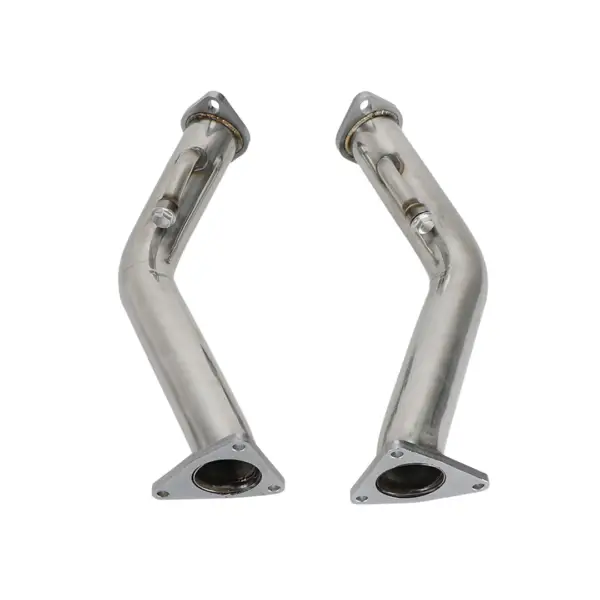
A non-resonated test pipe is exactly what it sounds like — a straight section of stainless steel tube with no internal baffling. Remove the cat, weld flanges on both ends, done. Maximum flow, maximum volume, zero attenuation of the exhaust note. Every frequency the VQ generates passes through uninhibited.
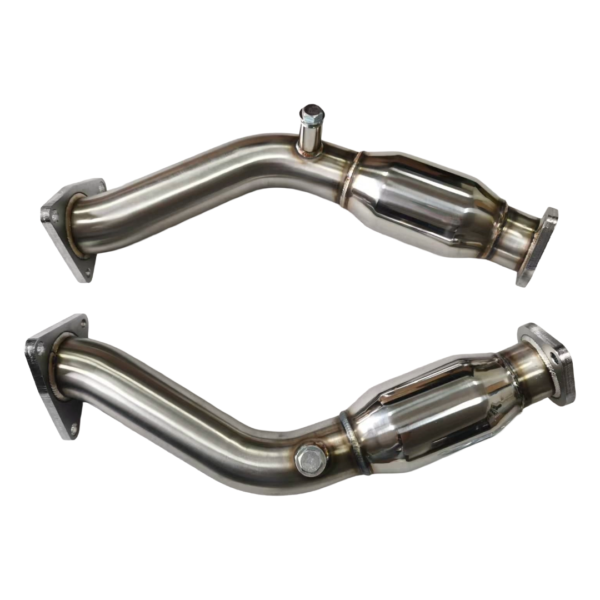
A resonated test pipe adds one more element to that design: a small resonator chamber integrated into the pipe itself. The resonator works by creating a dead-end cavity that targets specific exhaust frequencies — particularly the high-pitched rasp that VQ engines tend to produce without cats, and the mid-frequency drone that can fill the cabin at steady highway cruising speeds. It doesn't significantly restrict flow. It selectively cancels problem frequencies while keeping the deep, aggressive VQ character intact.
The result is two products that look similar on a spec sheet but sound and feel meaningfully different on the road. Here's how those differences play out in real driving conditions.
How each option performs across the driving conditions you'll actually encounter daily.
Both options are available now. Which one belongs on your car depends on how you drive it.
Performance is not the deciding factor here. Both options free up the same restriction in the exhaust path, and dyno results between resonated and non-resonated test pipes are statistically indistinguishable — we're talking a fraction of a wheel horsepower at most. The real question is what you're willing to live with between 1,500 and 2,500 RPM on the freeway.
Highway cruising on the VQ37VHR with non-resonated test pipes creates drone. The specific frequencies generated by a straight-through pipe at steady throttle — typically around 70 mph — land right in the range that couples into the cabin. Some owners adapt to it. Others find it exhausting on anything longer than a 20-minute commute. Resonated pipes target those frequencies specifically, and the result is a car that sounds genuinely aggressive under load without the punishment during relaxed driving.
Regular commutes, road trips, or any situation where you're sitting at cruising RPM for extended periods. The resonated pipes let the VQ breathe and sound great without turning every drive over 60 mph into a fatigue exercise. You still get the full performance benefit — just without the drone tax.
Weekend drivers, dedicated track builds, or owners who genuinely want the loudest possible VQ37 exhaust note and don't mind the volume on the street. Non-resonated pipes at wide-open throttle are genuinely aggressive — the kind of exhaust note that turns heads in the paddock. Just know what you're signing up for on the highway.
This is the most common misconception in the exhaust modification world. A resonator chamber in a test pipe does not meaningfully restrict exhaust flow. The resonator works acoustically — it creates a tuned dead-end cavity that cancels specific sound frequencies through destructive interference. The main exhaust path remains a free-flowing tube. Measured dyno results between resonated and non-resonated test pipes on the VQ37VHR show no consistent difference in peak or average wheel horsepower.
The 370Z/G37 Resonated Test Pipes from Chaser Automotive use 1.5mm stainless steel with precision-welded 10–12mm flanges. The integrated resonator is built into the pipe without narrowing the bore diameter — so flow characteristics stay consistent with the non-resonated option. The sound reduction is real and meaningful. The power cost is negligible.
If someone tells you that resonated pipes are slower because the resonator creates backpressure, they're wrong. That myth comes from confusing resonators with mufflers, which use packing material and baffled chambers that genuinely restrict flow. Resonators don't work that way.
Both test pipe options will trigger a check engine light on an untuned car. The factory secondary O2 sensors monitor catalytic converter efficiency — remove the cats, and the sensors will see the expected data falling out of range and throw a P0420/P0430 code. This is normal and expected with any test pipe installation.
The solutions are the same regardless of which pipe you choose. An UpRev or EcuTek tune disables the secondary O2 monitor at the ECU level — this is the cleanest approach and the one most tuners recommend. O2 sensor spacers (also called "Bung Buddies") physically relocate the sensor outside the exhaust stream and can eliminate the CEL without a tune, though a tune is always the preferred approach for a calibrated result. Port-based O2 simulators exist as well but are considered a workaround rather than a real solution.
Every key spec and characteristic compared directly between both Chaser options.
| Feature | 370Z/G37 Resonated Test Pipes | Kents 370Z/G37 Test Pipes |
|---|---|---|
| Price | $285 (sale from $310) | $235 |
| Material | 1.5mm stainless steel | Stainless steel |
| Resonator | Yes — integrated, tuned | None — straight-through |
| Estimated HP Gain (stock tune) | 5-8 whp | 5-8 whp |
| Highway Drone | Low — significantly reduced | High — noticeable 60–80 mph |
| High-RPM Rasp | Minimal — frequencies filtered | Significant — raw exhaust tone |
| Volume Level | Loud (daily-livable) | Very loud (max aggression) |
| Hardware Included | Yes — gaskets & bolts | Yes — hardware included |
| Platform Fitment | VQ37VHR + VQ35HR (broad fitment) | VQ37VHR |
| Best For | Street / daily / street-track | Track / weekend / max volume |
| Verified Reviews | 5/5 stars (3 reviews) | — |
Test pipes do most of their work between the engine and the mid-pipe. To get the most out of them, the rest of the exhaust path matters. Resonated test pipes pair naturally with a resonated Y-pipe downstream — Chaser carries the Stainless Steel Resonated Y-Pipe for the 370Z/G37 at $349.99, which continues the drone-reduction work further back in the system. If you go non-resonated test pipes, a resonated Y-pipe can partially offset the drone without giving back the peak volume.
Long tube headers are the logical companion mod upstream. Where test pipes open up the secondary cat section, headers address restriction at the primary manifold and primary cat location. The non-resonated test pipes in combination with Kents long tube headers create a genuinely aggressive exhaust note that's built for track use. The resonated combination gets you the same top-end performance with a significantly more refined street character.
A tune unlocks the full potential of either setup. Without calibration, the ECU is still pulling timing and managing fueling to compensate for the factory cats it now can't find. An UpRev or EcuTek tune dialed specifically for your exhaust setup typically adds another 5–10 whp on top of the bolt-on gain and makes the power delivery feel more linear throughout the rev range.
Test pipe installation on the 370Z and G37 is a straightforward afternoon job for anyone with basic mechanical skills and access to a lift or jack stands. Remove the cats, fit the new pipes, torque to spec. The flanges on both Chaser options are precision-cut for a direct fit without modification to the surrounding exhaust sections.
A few practical notes: the "demon bolts" — the cat hardware accessed from above the exhaust system — are notorious for seizing from heat and age on older Z cars and G37s. Soaking them in penetrating oil 24 hours before the install is worth doing. Both test pipe options include fresh gaskets and hardware, so you won't need to reuse the original fasteners. Torque the new flanges evenly and check for leaks after the first heat cycle.
The resonated vs non-resonated test pipe debate doesn't have a universally correct answer — it has the right answer for how you use your car. If your 370Z or G37 is a daily driver or a street-focused build, the resonated test pipes are the move. You get every bit of the performance benefit, the VQ opens up and sounds genuinely great at full throttle, and you don't spend every highway commute fighting a drone that wears you down over time. The 8% sale price makes the decision even easier.
If the car lives at the track, if you're building something that isn't meant to be comfortable at cruise, or if you simply want the loudest possible version of the VQ exhaust note and you're fine with everything that comes with it — the non-resonated Kents test pipes at $235 are exactly what they claim to be. No frills, maximum flow, maximum volume.
Either way, test pipes remain one of the best value-per-dollar modifications available for the VQ37VHR platform. The factory cats are a genuine restriction that the engine was built to breathe past. Remove them, tune the ECU, and the VQ37VHR gets closer to what it was always capable of.
Both test pipe options are in stock now. Pick your sound, bolt them on, and hear what the VQ37VHR actually sounds like when it's not fighting the factory cats.