
No products in the cart.
All products
Chaser Automotive
Chaser Automotive — Buyer's Guide
Best Cold Air Intakes for the
Nissan 370Z & Infiniti G37
A platform-specific breakdown of what works, what doesn't, and which intake gets the most out of the VQ37VHR without unnecessary complexity.
370Z | G37
VQ37VHR Engine
2009–2020 / 2008–2013
Buyer's Guide 2026
The VQ37VHR is one of the most responsive naturally-aspirated V6 engines to come out of any Japanese sports car platform in the last twenty years. Nissan built this engine to rev — 7,500 RPM redline, variable valve timing on both cams — and it rewards every cubic foot of additional airflow you give it. The factory intake does its job well enough to satisfy emissions regulations and NVH targets, but it's not built to maximize what the engine can breathe. That's the opening a quality cold air intake fills.
An aftermarket cold air intake for the 370Z or G37 is one of the most accessible performance mods on the VQ37VHR platform: bolt-on, no tune required in most cases, and the difference in throttle response and induction sound is immediate. But the intake market is crowded, and not everything sold for the VQ37 is actually built for it. Pipe sizing, silicone quality, filter placement, and MAF compatibility all determine whether you're getting a real improvement or just a noisier engine bay.
This guide covers what you need to know about cold air intakes on the VQ37VHR — what to look for, what to avoid, and which intake we recommend for the 370Z and G37. Whether your build is street-focused, track-prepared, or somewhere in between, here's how to make a smart choice from the start.
What Is a Cold Air Intake — and Why Does the VQ37VHR Benefit From One?
The VQ37VHR displaces 3.7 liters and produces 332 horsepower in the 370Z NISMO and 330 hp in the base 370Z and G37 coupe — all from a naturally-aspirated platform with no forced induction. That means every performance gain comes from mechanical efficiency: exhaust flow, ignition timing, combustion quality, and intake airflow. Unlike a turbocharged engine where additional fueling can compensate for airflow restrictions, the VQ has to make do with what it can pull in. Give it more, cooler air and it responds.
The factory airbox on the Z34 and V36 routes intake air through a restrictive plastic box with a paper filter element, designed first for noise reduction and emissions compliance. Under hard acceleration — especially above 5,000 RPM where the VQ really starts pulling — this becomes a bottleneck. A well-designed cold air intake replaces the restrictive factory routing with larger-diameter aluminum piping and a high-flow filter, drawing from a cooler area of the engine bay where inlet air temperature is lower. Cooler air is denser air, and denser air means more oxygen per combustion cycle.
The practical results on the VQ37VHR: improved throttle response particularly in the mid-range, a noticeably more aggressive induction tone under hard acceleration, and better volumetric efficiency at the top of the rev range where the engine likes to live. This isn't a turbo kit — but for a bolt-on modification that takes an afternoon to install, few mods on the platform deliver as immediate a change in how the car feels to drive.
Cold Air vs. Short Ram: What Actually Matters for the 370Z
Every intake marketed as a "cold air intake" isn't actually pulling cold air. Short ram intakes position the filter directly next to the throttle body — which is simple and affordable, but puts the filter inside the upper engine bay where heat soak is a real issue. Under slow-speed driving, sitting in traffic, or on track cool-down laps, a short ram can pull air that's warmer than what the factory airbox ingests. Larger pipe diameter doesn't compensate for increased inlet air temperature.
A proper cold air intake routes piping to pull from lower in the engine bay or in front of the radiator support — where ambient airflow is available and engine heat soak is reduced. This distinction matters on a naturally-aspirated engine like the VQ37VHR where air density directly translates to power. An inlet air temperature increase of even 10°F can reduce effective volumetric efficiency and cause the ECU to retard timing — undoing the benefit of the larger intake path entirely.
When evaluating intakes for the VQ37VHR platform, filter placement and heat shielding are just as important as pipe diameter. A 2.5-inch intake routed away from engine heat will outperform a 3-inch intake sitting in the middle of a hot engine bay every time.
What to Look for in a 370Z / G37 Cold Air Intake
The VQ37VHR intake market is crowded. Here's the criteria that separates the quality builds from the noise:
- Pipe diameter: The VQ37VHR throttle body runs approximately 2.5 inches internally at the inlet. A full 2.5-inch intake system matches this without over-piping, which can cause low-velocity turbulence at partial throttle. Larger 3-inch intakes are better suited to tuned builds with supporting exhaust and fueling modifications.
- Silicone hose construction: The flexible connectors between hard pipes and throttle body are where quality separates quickly. Multi-ply, wire-reinforced silicone prevents collapse under vacuum and handles the heat cycling in the 370Z engine bay without cracking. Single-ply silicone degrades faster and creates vacuum leaks.
- MAF sensor compatibility: The 370Z and G37 use a mass airflow (MAF) sensor that must be retained in any properly functioning intake system. Intakes designed to use the factory MAF location avoid the need for ECU recalibration and are the safe choice for untuned builds.
- Filter placement and heat shielding: Confirm where the filter sits relative to the engine block and radiator. Look for systems that route away from direct engine heat, not just large-diameter pipes that terminate an inch from the valve covers.
- Installation complexity: Some 370Z intakes require cutting the radiator support or removing the front bumper to complete the routing. True direct-fit systems require no permanent modifications and a fraction of the install time.
- PCV system compatibility: The VQ37VHR positive crankcase ventilation system connects to the intake and must be maintained in any aftermarket intake install. The Chaser kit includes a silicone PCV breather hose set — this is part of the complete kit, not a separate purchase.
Platform note: The Nissan 370Z (Z34 chassis, 2009–2020) and Infiniti G37 (V36 chassis, 2008–2013) share the VQ37VHR engine and compatible intake fitment. Most quality intakes are confirmed for both platforms across coupe, sedan, and convertible variants — but always verify your specific variant before ordering as minor routing differences exist.
Chaser Automotive Picks
Our Recommended Intakes for the VQ37VHR
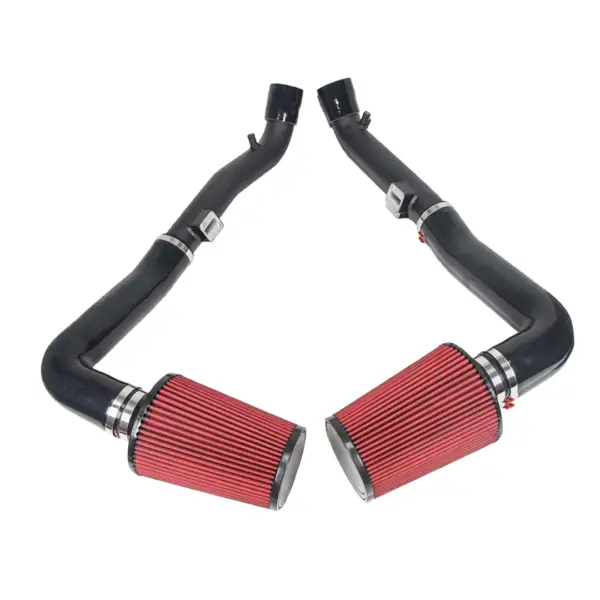
Top Pick
370Z/G37 High Flow Cold Air Intake
Nissan 370Z (2009–2020) | Infiniti G37 (2008–2013) | VQ37VHR
- Full 2.5-inch high-flow system — properly sized for the VQ37VHR throttle body
- 5-ply wire-reinforced silicone — no collapse under vacuum or heat cycling
- No V-brace or front bumper removal required — true direct fit
- Retains OEM MAF sensor location — no tune required on stock/mild builds
- High-flow velocity stack air filters included — improved intake velocity and filtration
- Aluminum hard pipes, adapters, reducers, and coupler clamps all included
$409.99
Shop the High Flow Cold Air Intake
Why the Chaser 370Z/G37 High Flow Cold Air Intake Gets the Sizing Right
One of the common misconceptions in the intake market is that bigger always means better. A 3-inch intake sounds impressive on a spec sheet, but on a stock VQ37VHR the throttle body inlet is approximately 2.5 inches — which means a 3-inch intake pipe creates an abrupt diameter drop right before the throttle plate. At partial throttle and cruise conditions, this mismatch can generate turbulence in the intake tract rather than smooth, laminar airflow. The engine is calibrated by the factory for a specific airflow range, and an oversized intake that disrupts charge motion doesn't help it.
The Chaser 370Z/G37 High Flow Cold Air Intake runs a full 2.5-inch system — matched to the VQ37VHR throttle body for consistent airflow velocity across the RPM range. The aluminum hard pipes are paired with 5-ply wire-reinforced silicone at every flexible connection point, which is the construction detail that matters most for long-term durability. Thin silicone hoses degrade under the heat cycling in any performance engine bay; wire-reinforced multi-ply silicone holds form under pressure and stays pliable through temperature extremes.
The direct-fit design is another practical differentiator. No cutting of the radiator support, no front bumper removal — the system routes and mounts using existing attachment points. Combined with the included velocity stack filters, silicone PCV breather hose set, and the full hardware kit, this is a one-afternoon install that doesn't require improvisation.
How They Stack Up
370Z / G37 Cold Air Intake Comparison
| Feature | Chaser High Flow Cold Air Intake | Z1 Motorsports CAI | GKTech No-Cut CAI | AdminTuning 3" Intake |
|---|---|---|---|---|
| Price (Approx.) | $409.99 | ~$349–$399 | ~$420–$450 | ~$399 |
| Pipe Diameter | 2.5" — throttle body matched | 3" — oversized for stock TB | 2.5" | 3" — oversized for stock TB |
| Silicone Hose Quality | 5-ply wire reinforced | Multi-ply (standard) | Multi-ply (standard) | Multi-ply (standard) |
| No Bumper/V-Brace Removal | ✓ True direct fit | Varies by variant | ✓ No-cut design | Varies by variant |
| Retains OEM MAF Location | ✓ Yes | ✓ Yes | ✓ Yes | ✓ Yes |
| Tune Required (stock build) | Not required | Not required | Not required | Recommended for 3" |
| Velocity Stack Filter | ✓ Included | Cone filter | Cone filter | Cone filter |
| PCV Hose Included | ✓ Included in kit | Not included | Not included | Not included |
| 370Z & G37 Compatibility | ✓ Both confirmed | ✓ Both confirmed | ✓ Both confirmed | ✓ Both confirmed |
Competitor prices are approximate based on publicly available market data as of 2026. Competitor products mentioned by name only — no external links. Specs sourced from publicly available product listings and cross-referenced before inclusion.
Which Intake Is Right for Your 370Z or G37 Build?
For a street-focused 370Z or G37 — daily driven, weekend canyon runs, occasional track days — the Chaser 370Z/G37 High Flow Cold Air Intake is the straightforward call. The 2.5-inch full system is correctly sized for the stock VQ37VHR throttle body, the 5-ply silicone construction will outlast cheaper options, and the direct-fit design means no permanent modifications and a realistic afternoon install. No tune required on a stock or mildly modified engine.
For builds running a tune, headers, and a full exhaust — where the rest of the engine's airflow is significantly opened up — a larger 3-inch intake becomes relevant as you're no longer limited by the factory throttle body as much as the overall system flow. But on a stock or stage-one build, the 2.5-inch intake is the better match, not a compromise.
Final Thoughts
The VQ37VHR doesn't need much help — Nissan already built an engine that wants to be driven hard. But the factory intake system leaves real performance on the table, particularly in the 4,500–7,500 RPM range where the VQ rewards every improvement you make to airflow. A quality cold air intake is one of the most cost-effective ways to get more out of the platform you already have without touching the engine internals or requiring a tune.
The Chaser 370Z/G37 High Flow Cold Air Intake is purpose-built for this platform: properly sized pipe diameter, premium silicone construction, direct fit, and a complete hardware kit. If you're ready to open it up and let the VQ breathe, this is the right place to start.
Common Questions
370Z & G37 Cold Air Intake FAQ
On a naturally-aspirated engine like the VQ37VHR, a cold air intake improves airflow and reduces inlet air temperature — both of which contribute to better volumetric efficiency and more complete combustion. The most noticeable real-world effect is improved throttle response and mid-range pull rather than a dramatic peak horsepower number. Owners consistently report a seat-of-the-pants difference particularly between 4,500 and 7,000 RPM. Dyno-measured gains vary based on the specific intake design, pipe sizing, filter placement, and whether the car is tuned. An intake is not a horsepower mod in isolation — it's an airflow improvement that complements the rest of your build.
In most cases, no. Intakes that retain the factory MAF sensor in its original location — like the Chaser 370Z/G37 High Flow Cold Air Intake — do not require a tune on a stock or mildly modified VQ37VHR. The factory ECU uses adaptive fuel trims that can compensate for the modest airflow changes introduced by a properly sized intake. If you're running a larger intake on a tuned engine with supporting modifications, a professional tune will maximize the intake's contribution to overall performance. But for a stock or lightly modified car, you can bolt it on and drive.
The Chaser 370Z/G37 High Flow Cold Air Intake fits the Nissan 370Z (Z34 chassis, 2009–2020) and the Infiniti G37 (V36 chassis, 2008–2013). Both vehicles run the VQ37VHR engine and share compatible intake fitment. This covers the coupe, sedan, and convertible variants of both platforms. If you have a specific variant or year you're uncertain about, check the product listing or reach out to confirm before ordering.
The kit includes: aluminum intake hard pipes, a silicone straight reducer hose, a silicone throttle body to hard pipe adapter, an aluminum 90° hose-to-filter adapter, high-flow velocity stack air filters, a silicone side PCV breather hose set, and all intake coupler clamps. Everything needed for a complete install on a stock 370Z or G37 is in the box — no sourcing additional hardware or making modifications to get it fitted.
For a stock or mildly modified VQ37VHR, a 2.5-inch intake is the better match. The factory VQ37VHR throttle body inlet is approximately 2.5 inches — a 3-inch intake creates an abrupt step-down right before the throttle plate, which can introduce turbulence in the intake charge at partial throttle and cruise conditions. A 3-inch intake becomes more relevant on a heavily modified, tuned build where the throttle body has been ported or upsized, and the rest of the airflow path is opened up significantly. If you're running a stock throttle body and ECU tune, stay with 2.5 inches for better matched airflow velocity and consistent performance across the RPM range.
In steady-state highway driving, a properly sized cold air intake can marginally improve fuel economy by contributing to more efficient combustion. In practice, most owners find fuel economy stays roughly the same, because improved throttle response tends to encourage a more engaged driving style — which is the correct response. If you're buying a cold air intake for fuel economy, that's the wrong motivation. If you're buying it for throttle response, induction sound, and as a foundation for further mods, the value is clear.
Ready to Let the VQ37VHR Breathe?
The Chaser 370Z/G37 High Flow Cold Air Intake is in stock and built for the platform. Everything you need for a complete install — including the silicone PCV breather hose set — is in the box.
Copyright 2023 bumbleb. All Rights Reserved.